
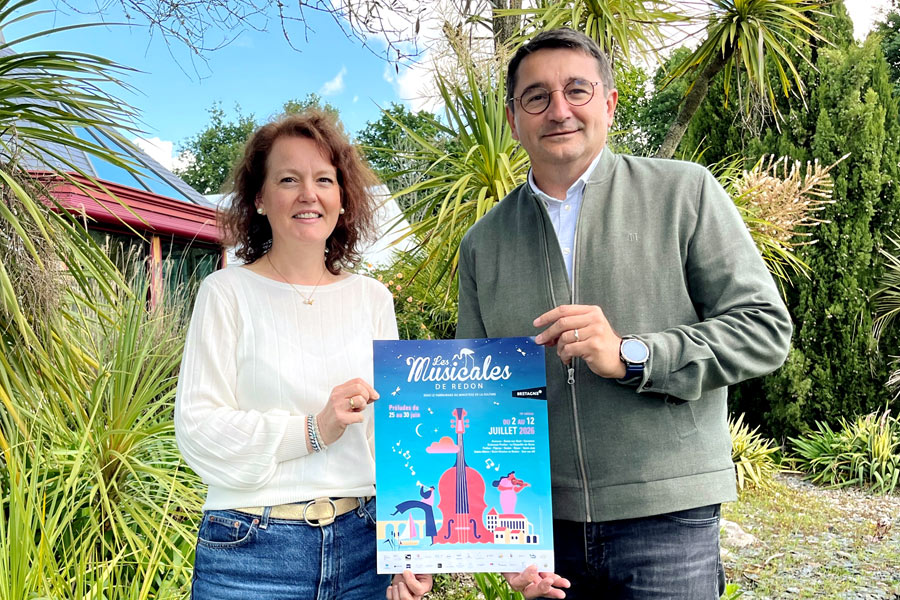
For several years now, ADEOS has been supporting Les Musicales de Redon.
It is a discreet yet deeply committed partnership, rooted in a shared conviction: a region is built not only through the economy, but also through the emotions, connections, and cultural experiences it fosters.
Through this dialogue, Isobel Bailey and Laurent Anezot-Lallemand discuss artistic excellence, the transmission of culture, cultural democratization, and the role that businesses can play in promoting the local community.
Les Musicales has long championed a very open approach to classical music. Why this commitment?
Isobel Bailey:
Very early on, we realized that we couldn't put on a festival just for insiders. Otherwise, we'd quickly end up in a closed circle.
Our motto is “music for all hearts.” It refers to the heart in an emotional sense, but also to all audiences.
We visit schools, nursing homes, community centers, medical-social facilities, and businesses as well. Because there are people who would never come to a concert on their own. And yet, sometimes all it takes is a single moment, an artist, or a piece of music for something to click.
I remember an elderly gentleman I met at the entrance to a concert. He had walked all the way from his nursing home after attending a musical performance that afternoon. He wanted to hear “the real concert.” It’s moments like these that keep us going.
Laurent Anezot-Lallemand:
That's exactly what I find so impressive about this festival.
You can sense that there’s a genuine desire to open doors—not to artificially simplify things, but to give everyone access to something challenging.
And I think many people discover here an emotion they never imagined they could feel through classical music.
That is also what gives a region its value: its ability to offer something beyond the functional routines of daily life. A region that fosters growth, broadens horizons, and creates shared experiences naturally becomes more vibrant, more attractive, and more human.
You're both talking about "high standards." Why does that word come up so often?
Laurent Anezot-Lallemand:
Because it's obvious.
When you watch these musicians perform—sometimes for an hour—with such precision, such mastery, and such concentration… it’s truly exceptional. Even if you’re not an expert, you can immediately sense the level of personal dedication behind it all.
What Les Musicales offers is this closeness to excellence. Seeing the glances, the silences, sensing what’s happening between the artists… it makes this high standard almost tangible.
And, of course, this resonates with me as a business leader as well. In our line of work, the daily demands, the behind-the-scenes work, the attention to detail, and teamwork—these are very real and significant aspects of our work.
I think it’s important for companies to also support initiatives that foster this culture of excellence. Because, ultimately, they, too, help elevate the region.
Isobel Bailey:
Yes, and what's beautiful about classical music is that this high standard is directed toward something that transcends the artists themselves.
In this repertoire, the works are the stars. The performers come and go, but the works endure through the centuries.
When a major work from the repertoire is announced, the musicians know that every nuance and every intention will be scrutinized. That requires an enormous commitment.
And that’s also what really moves the audience: seeing people who devote so much time, energy, and sensitivity to their art.
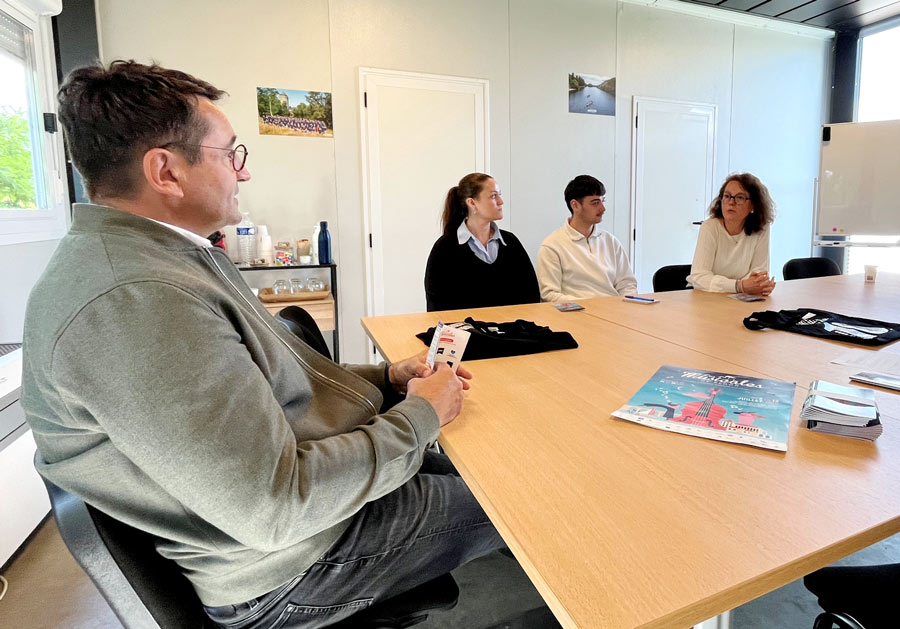
The worlds of business and culture are often seen as opposites. Yet you seem to speak the same language.
Isobel Bailey:
I think that's a very French way of compartmentalizing things.
Music is a part of our lives from beginning to end. Happy moments, difficult times, memories… it’s everywhere. Why should the business world remain detached from all of this?
Artists need an ecosystem to continue creating and sharing their work. And when local businesses make a long-term commitment, it creates something very cohesive.
Laurent Anezot-Lallemand:
I completely share this view.
A company doesn't exist apart from the community. It is part of it.
When we talk about attractiveness, we often talk about jobs, the economy, infrastructure… but people also look at quality of life, cultural events, and the collective energy of a region.
Festivals like Les Musicales give the Redon region its identity, character, and spirit. And that matters a great deal.
I sincerely believe that a company also has a cultural responsibility toward its local community. Not in the moral or institutional sense of the term, but because it benefits from that community itself: from its residents, its schools, its energy, and its image.
When a local initiative raises the profile of a region with such high standards and quality, it seems natural to me that businesses would take an interest and contribute to this momentum in their own way.
This is also what makes partnerships with locally engaged organizations—such as the Banque Populaire Grand Ouest (BPGO) Foundation—so valuable, as they help bring these kinds of initiatives to life in the region.
ADEOS has been supporting Les Musicales for several years. How do you view this commitment?
Laurent Anezot-Lallemand:
I prefer to talk about support rather than sponsorship in the sense of “publicity.”
I'm still a little uncomfortable with the idea of giving a company too much attention simply because it supports a cultural event.
What interests me most is the idea that ADEOS is quietly contributing to something meaningful.
We share common values: high standards, a commitment to people, and passing on knowledge. And I think it’s only natural for a local business to help bring events of this caliber to life.
Ultimately, it’s not about “supporting culture” as if you were checking a box. It’s about supporting initiatives that make a region more vibrant, more open, and more attractive.
And this also has very tangible effects: when we want to attract employees, families, and young talent, we need to be able to tell them that something is happening here—that there’s a vibrant cultural life, a shared sense of purpose, and events that foster a sense of community and local pride.
Isobel Bailey:
And for us, this commitment is valuable because it is long-term.
ADEOS has been supporting the festival for several years now. One highlight was that very original concert featuring the sounds of industrial machinery, which left a lasting impression on the audience.
This kind of support shows that there are businesses here that are deeply rooted in their local communities and that view culture as an integral part of local life.
Beyond the music, the festival also has a very strong educational and social dimension.
Isobel Bailey:
Yes, deeply.
When we visit schools, ITEPs, or community centers, we sometimes see children who are fascinated by what they discover.
They ask how many hours a musician works each day. When they hear “eight hours,” they can’t believe it. But it also inspires respect. They understand what lies behind excellence: hard work, perseverance, and discipline.
And sometimes, it stirs something within them—a curiosity, a desire, a vision.
Laurent Anezot-Lallemand:
That is also why these events are important.
Culture helps us grow. It broadens our horizons. It allows people who may not have felt they belonged to discover new things and experience new emotions.
And I truly believe that a region needs this. It needs places where people can be surprised, moved, and inspired.
When a company supports this type of initiative, it is not merely supporting an event. In a sense, it is also contributing to the human and cultural development of the region.
It seems like both of you are saying that a festival like Les Musicales goes far beyond the mere cultural sphere.
Laurent Anezot-Lallemand:
Yes, because today, this festival has become an integral part of the region.
There was nothing that necessarily destined Redon to become a renowned destination for classical music. It exists because people believed in it and worked tirelessly for years. I think we can thank them—and first and foremost, Henry de Sonis, the festival’s founder.
I think it's important for local businesses to recognize the value of this kind of initiative.
The more cultural events of this caliber we have, the more the region will gain in appeal, uniqueness, and influence.
And I believe that businesses must play a full part in this collective effort. Not to raise their profile. Not for the sake of publicity. But because it is also in their best interest to see their region grow, become stronger, and flourish.
Isobel Bailey:
And what's important is that everyone does their part, in their own way.
We have always sought to maintain a balance between ticket sales, private support, and public funding. Because a vibrant festival depends on collective commitment.
And this balance would not exist without partners who truly understand the importance of access to culture in a region. The BPGO Foundation now plays a very important role in this effort, particularly through the Endowment Fund, which provides concrete support for our development and our cultural outreach initiatives.
Culture is never free—it comes at a cost! Behind every concert, there are artists, crews, hard work, rehearsals, sheet music, technicians…
But what we get in return is immense: emotions, memories, encounters, and sometimes even personal transformations.
Ultimately, what is it that brings you together most in this partnership?
Laurent Anezot-Lallemand:
The idea that a region must continue to offer powerful, human, and challenging experiences.
And that a company can contribute to this in a simple, unpretentious way—simply because it believes in the importance of those moments.
Isobel Bailey:
Yes. Deep down, perhaps what we share most of all is this desire to enable more people to experience moments that truly matter.
—
About the Redon Music Festival
For more than fourteen years, Les Musicales de Redon has been bringing to life, in the heart of the Pays de Redon, a festival deeply rooted in its local community and driven by artistic excellence, sharing, and openness. Year after year, the festival brings together artists, volunteers, partners, and audiences around a rich and thoughtful program that blends artistic styles, generations, and new connections.
Much more than just a cultural event, Les Musicales is a human and collective adventure that helps promote the region and provide everyone with access to vibrant, challenging, and enriching music.
—
Make a donation to support the event with the BPGO Foundation
As part of the 2026 Musicales de Redon festival, a fundraising campaign is being launched with the support of the Banque Populaire Grand Ouest Foundation, a committed partner in cultural and community development in the region.
Thanks to the Endowment Fund managed by the BPGO Foundation, donations made by companies and individuals can be matched, with ADEOS also contributing to these matching funds, thereby providing tangible additional support for Les Musicales.